A pocket agronomist and market advisor for the world's smallest farms.
FarmPilot turns an ordinary smartphone into an AI copilot that helps a smallholder farmer protect a crop, time a sale, and get expert guidance spoken in their own language.
Built for the hundreds of millions of smallholder farms that feed much of Asia.Smallholdings under one hectare run most farms in Korea and across much of Asia, yet they operate on the thinnest margins and with the least access to the two things that decide a season's income: timely agronomy expertise and market information.
A pest caught a week late, or a harvest sold on the wrong day, can erase a season's profit. Climate stress is widening both gaps at once, with unfamiliar pest patterns and more volatile yields and prices. Expert advice exists, but not in the field, not in real time, and rarely in a form a busy farmer can act on.
Point the phone at a sick plant. A vision model identifies the pest or disease and suggests a treatment, running on the device so it works offline in the field.
Computer visionFarmPilot models price trend and volatility to help decide when and where to sell, turning market data into a plain recommendation instead of a spreadsheet.
Time-series modelingAsk anything by voice, in your own language or dialect. A language model answers in words a farmer uses, so the tool serves people with low digital or text literacy.
Language modelThe diagnosis model is built and measured, not a mockup: 97.8% validation accuracy on the PlantVillage benchmark, in a 6 MB model light enough to run on-device. Below are actual outputs on held-out leaf images the model never trained on.
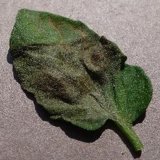
Act fast: remove infected plants, avoid overhead irrigation, and apply a labeled fungicide preventatively. Late blight can destroy a crop within days.
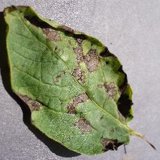
Rotate crops away from solanaceous hosts, remove infected debris, and apply a labeled fungicide starting at first symptoms.
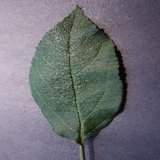
No disease detected. Continue routine monitoring and balanced watering, and re-check if new spots or discoloration appear.
These are PlantVillage benchmark images (single leaves on plain backgrounds), so real in-field accuracy will be lower. This is an early prototype and not a substitute for an agronomist. The model, training pipeline, and a runnable demo app are available to reviewers on request.
The hard part of agtech for smallholders is not the models, it is delivery. FarmPilot is designed around how a farmer actually works: on a basic phone, with patchy connectivity, no time to type, and no technical training.
On-device and offline-first. Diagnosis runs on the phone, so a dead zone in the field is not a dead end.
Voice and dialect native. The assistant meets farmers in spoken local language, not menus and forms.
Three model types, one surface. Vision, forecasting, and language fused into a single copilot a non-technical user can trust.
Every crop lost to a missed diagnosis, and every harvest sold badly, is food and income gone from a household with little to spare. Helping smallholders lose less and earn more is climate adaptation delivered to the front line.
Smallholders steward a large share of Asia's farmland and food supply while absorbing the sharpest edge of a changing climate. FarmPilot starts in Korea and is built for the smallholder pattern common across the APAC region.
Building the on-device diagnosis model and the voice interface, and defining the price-timing decision support with real market data.
A first field pilot with smallholder farmers and agronomy advisors, to test whether the guidance changes real decisions.
Extend from Korean crops and dialects toward the wider APAC smallholder market.